Concrete Vibrators Overview: Working Principles, Key Facts, and Informative Insights
Concrete vibrators are construction tools designed to remove trapped air and excess water from freshly poured concrete. When concrete is poured into formwork, air pockets naturally form inside the mixture. If left untreated, these voids weaken the structure and reduce durability.
Concrete vibrators exist to solve this issue by applying controlled vibration to freshly poured concrete. The vibration causes concrete particles to settle tightly together, allowing air bubbles to rise to the surface and escape. This results in a denser, stronger, and more uniform concrete structure.
The use of concrete vibration became essential as construction projects evolved from small masonry works to large-scale infrastructure such as bridges, buildings, dams, and highways. Modern construction standards now recognize vibration as a fundamental step in concrete placement.
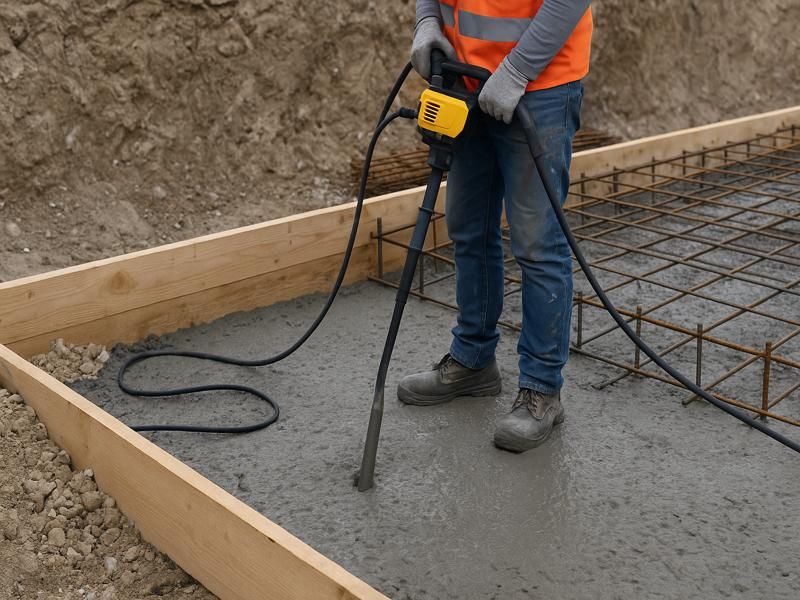
Importance: Why Concrete Vibrators Matter Today
Concrete vibrators play a critical role in construction quality, safety, and longevity. Their importance has increased as modern structures demand higher strength, longer service life, and better resistance to environmental stress.
Key reasons concrete vibrators matter:
-
Structural Strength: Proper vibration improves concrete density and load-bearing capacity
-
Durability: Reduces cracking, honeycombing, and surface defects
-
Safety: Ensures structural integrity in buildings, bridges, and foundations
-
Efficiency: Helps achieve uniform concrete placement in less time
-
Compliance: Meets modern engineering and construction quality standards
Concrete vibrators affect a wide range of professionals, including civil engineers, site supervisors, quality inspectors, infrastructure planners, and construction workers. They help solve common problems such as weak concrete zones, uneven surfaces, premature deterioration, and structural failures.
In large-scale projects, poor concrete compaction can lead to long-term maintenance challenges and safety risks. Proper vibration helps prevent these issues at the construction stage itself.
Working Principles of Concrete Vibrators
Concrete vibrators operate by generating rapid oscillations that temporarily liquefy concrete, allowing particles to rearrange and compact effectively.
Basic working process:
-
The vibrator creates high-frequency vibrations
-
Vibrations reduce internal friction between concrete particles
-
Trapped air bubbles move upward and escape
-
Concrete settles evenly into corners and around reinforcement
Main types of concrete vibrators and their principles:
| Type | Working Principle | Common Use |
|---|---|---|
| Internal (Needle) Vibrator | Vibrating head inserted into concrete | Columns, beams, slabs |
| Surface Vibrator | Vibrations applied from the surface | Pavements, slabs |
| External Vibrator | Vibrations transmitted through formwork | Precast elements |
| Vibrating Table | Entire mold vibrated uniformly | Precast blocks, panels |
Each type is selected based on project size, concrete consistency, reinforcement density, and formwork design.
Recent Updates: Trends and Developments (2024–2025)
Concrete vibration technology has seen noticeable improvements in recent years, focusing on efficiency, durability, and operator safety.
Recent developments include:
-
2024: Increased adoption of energy-efficient vibration systems to reduce power consumption
-
2024: Improved vibration frequency control for better compaction consistency
-
2025: Lighter materials used in vibrator shafts to reduce operator fatigue
-
2025: Enhanced sealing methods to improve performance in wet and harsh environments
Another trend is the growing emphasis on quality monitoring, where vibration duration and placement patterns are more closely controlled to avoid over-vibration. Over-vibration can cause material segregation, so controlled application has become a focus area.
Infrastructure projects in 2024–2025 increasingly emphasized vibration best practices as part of construction quality audits, especially in high-load and seismic zones.
Laws, Standards, and Regulatory Guidelines
Concrete vibration practices are influenced by engineering codes, construction standards, and workplace safety regulations.
Commonly referenced standards include:
-
ACI (American Concrete Institute) Guidelines: Provide detailed recommendations for vibration techniques
-
IS 456 (India): Specifies compaction requirements for reinforced concrete
-
BS EN 206 (Europe): Covers concrete quality, placement, and compaction
-
OSHA Safety Guidelines: Address operator safety and vibration exposure
-
ISO Standards: Regulate equipment performance and workplace vibration limits
Many countries also promote training programs and construction quality frameworks that include proper concrete compaction methods. Government infrastructure projects often require documented compliance with vibration procedures to ensure structural durability.
Safety regulations emphasize protective equipment, proper handling, and limits on prolonged vibration exposure to protect workers from health risks.
Tools and Learning Resources for Better Understanding
Several educational and practical resources help professionals and learners understand concrete vibration principles and best practices.
Helpful tools and references include:
-
Construction engineering handbooks on concrete placement
-
Civil engineering textbooks covering concrete technology
-
Government publications on building and infrastructure standards
-
Technical charts showing vibration frequency ranges
-
Site checklists for proper compaction procedures
Learning platforms and knowledge sources:
-
University civil engineering departments
-
Professional construction associations
-
Infrastructure development authorities
-
Industry journals on concrete technology
-
Training manuals for site supervisors and engineers
These resources support better planning, safer operation, and higher-quality construction outcomes.
Key Facts About Concrete Vibration
Important facts to know:
-
Proper vibration significantly increases compressive strength
-
Insufficient vibration causes honeycombing and weak zones
-
Excessive vibration may lead to material separation
-
Vibration time depends on concrete mix and placement depth
-
Dense reinforcement requires careful vibrator positioning
Understanding these facts helps avoid common site-level errors and improves construction reliability.
Frequently Asked Questions (FAQs)
1. Why is vibration necessary in concrete construction?
Vibration removes trapped air and ensures uniform compaction, which improves strength, durability, and surface finish.
2. How long should concrete be vibrated?
Vibration should continue until air bubbles stop rising and the concrete surface becomes smooth, usually a few seconds per insertion point.
3. Can over-vibration damage concrete?
Yes. Over-vibration can cause segregation, where heavier particles settle and lighter components rise, reducing concrete quality.
4. Are concrete vibrators used in all types of construction?
Most reinforced and structural concrete applications require vibration, especially in columns, beams, slabs, and foundations.
5. What safety precautions are important during vibration?
Operators should use protective gear, avoid prolonged exposure, and follow equipment handling guidelines to reduce physical strain.
Helpful Tips for Effective Concrete Vibration
-
Insert vibrators vertically and evenly spaced
-
Avoid dragging the vibrator through concrete
-
Do not vibrate after concrete has begun to set
-
Ensure formwork is strong enough to withstand vibration
-
Coordinate vibration with concrete pouring speed
These practices help achieve consistent compaction and minimize defects.
Conclusion
Concrete vibrators are a vital part of modern construction, ensuring strong, durable, and safe concrete structures. By eliminating air voids and improving particle bonding, they enhance the long-term performance of buildings and infrastructure.
As construction standards continue to rise, proper vibration techniques, updated equipment, and regulatory compliance play an increasingly important role. Understanding working principles, recent developments, and best practices enables engineers, supervisors, and learners to contribute to safer and more reliable construction outcomes.
Concrete vibration is not just a technical step—it is a foundational process that supports the strength and longevity of the built environment.